30 Year Old Fiberglass Pressure Pipe Still Performing As Designed
One of Hobas’s first fiberglass pipes manufactured in their Houston, Texas plant in 1987 has been found to still be in use and still exceeding ASTM standards.
The significance of this find is that at more than twice the useful lifetime for other commonly used pipe materials under the same environmental conditions, this fiberglass pipe line has continued to exceed its initial installation requirements.
In June of 1987, Hobas announced the grand opening of their new fiberglass pipe facility in Houston, Texas. At the same time, a large provider servicing the west Texas oil field was in need of new service lines. The corrosion resistance of the pipe was a perfect match for the demanding environment.
West Texas Water Supply System (WTWSS), a privately owned commercial water delivery system serving the oil industry, was expanding its distribution lines. Two separate18-inch diameter lines were included in their project to deliver brackish water originating from the Capitan Reef Complex Aquifer to oil fields in the Midland – Odessa area. The WTWSS lines have changed ownership over the years, since been acquired by Centurion Pipeline L.P., which in turn have been acquired by Lotus Midstream LLC.
The groundwater pumped from this aquifer, located in southeast New Mexico and far west Texas, is transferred to regional oil fields for use in secondary recovery processes. This brackish water has a temperature normally around 90-95 degrees F and is contaminated with hydrogen sulfide and other minerals. Due to the water’s high salinity characteristics, pipes made of other commonly used materials experience a much shorter lifespan under these same conditions, as WTWSS had learned.
Engineers designing this project chose Hobas CCFRPM pipe because of its inherent outstanding corrosion resistance. The WTWSS management expected a 50-year or longer service life for the Hobas fiberglass pipes in this environment. Both pipelines utilized minimum pipe classes PN 150 (maximum 150 psi operating pressure), SN 36 (minimum 36 psi pipe stiffness).
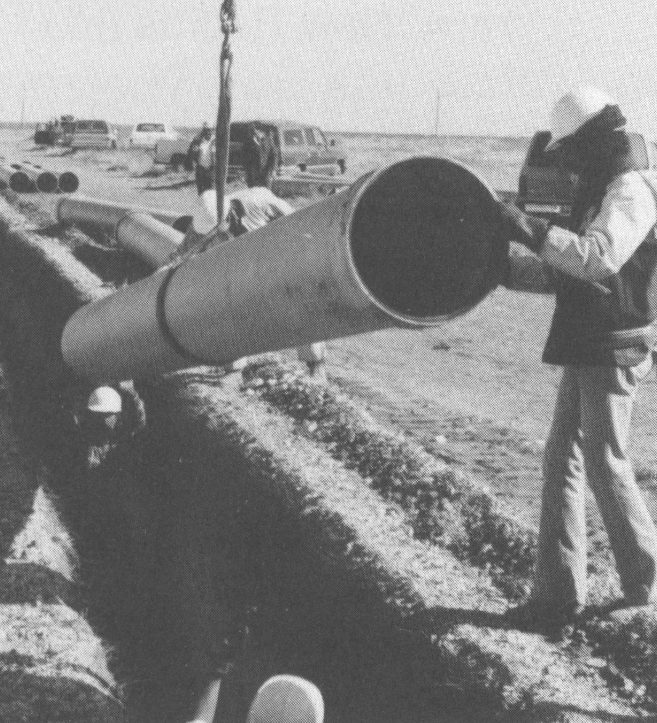
For installation, the Hobas CCFRPM was delivered in 20 foot sections and field assembled with HOBAS standard FWC couplings. The first phase was a 21,000-foot extension line to supply a Chevron field near Goldsmith, TX. Field tested to 185 psi, the line was put into service delivering 35,000 barrels per day. The second phase of their project included a 124,000 foot extension to supply a Texaco field on Mabee Ranch north of Midland, TX. Each of the lines was actually capable of delivering 120,000 barrels per day at capacity. Under normal operation, these lines are under between 75 and 100psi of pressure.
For over 20 years, these two lines were ‘out of sight — out of mind.’ But then an adjacent pipeline made of another material ruptured, damaging several segments of one of the existing Hobas lines. Within one week, the Hobas Pipe Houston plant manufactured and shipped 80 feet of new 18-inch diameter CCFRPM pipe to the west Texas repair site.
It is rare that segments of historical lines are available for testing before they reach their full life expectancy, as most remain in use for their lifetime. In this instance, Hobas was lucky enough to receive some of the 21.5-year-old pipe back at their plant where they determined that it was one of the first fiberglass pipes manufactured in the USA in November of 1987.
The damaged sample was inspected by outside testing facility that oversaw the testing of returned pipes. The third party evaluated the mechanical properties in accordance with the ASTM standards for the product. Physical testing of specimens included axial tensile strength and strain, hoop tensile strength, hoop flexural strength and strain, and axial compressive strength. In all cases, the results of these tests showed that the CCFRPM had exceeded the original ASTM requirements.
Quickly repaired, this line is once again, ‘out of sight — out of mind’ for many more years. To date Hobas has provided over 800,000 feet of pressure pipe in the USA alone.